









Sacs de sport personnalisés : compartiments pour vêtements mouillés, aération et points d'ancrage des sangles
7 août 2026
IONIA BAG Technical Team | Product & Export Content | Published: August 6, 2026
A custom gym bag survives daily use when three details are locked before sampling: a wet compartment with a defined liner and drain path, ventilation positioned to move air across damp fabric, and strap anchors stitched into a reinforced body panel rather than the lining. Fabric weight and logo placement are easier to change later.
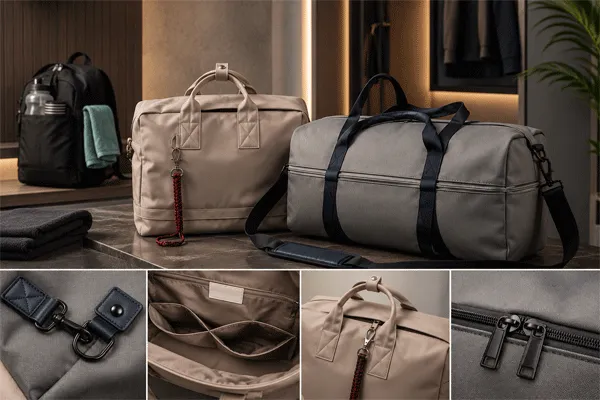
Most gym-bag complaints that reach a factory are not about fabric. They are about a wet towel that soaked a phone, a bag that smelled after two weeks, or a strap that tore out of the panel while the webbing itself stayed intact. Those are three separate construction problems with three separate fixes, and a promotional catalogue body can only solve them if it happened to be built that way from the start. Compared with the imprint-only route common in this category, where the body is fixed and only the logo changes, a custom program lets you change the panel that is actually failing.
Sacs de sport personnalisés : compartiments pour vêtements mouillés, aération et points d'ancrage des sangles
There are four workable approaches, and they are not interchangeable in cost or in repairability.
Lined pocket — a standard side or end pocket with a coated liner (PU or TPU laminate) sewn in. Cheapest to produce, easiest to add to an existing pattern. Water resists passing through the fabric but travels along stitch holes, so it holds a damp towel, not a wet swimsuit.
Welded liner pocket — liner seams heat-welded instead of sewn, eliminating needle penetration. Genuinely holds standing water. Requires welding equipment and adds tooling and sampling time; if your quantity is small, this is usually the first item that gets cut.
Drop-bottom compartment — a zippered lower section separated by a fabric or board divider. Great for shoes and for physically isolating wet items from dry ones. It eats interior height, so a 22-inch body suddenly feels like an 18-inch body upstairs.
External wet bag — a detachable pouch on a clip or webbing loop. Weakest integration, strongest hygiene story: the user can wash it separately, and a failed pouch does not condemn the whole bag.
| Dimension | Lined pocket | Welded liner | Drop-bottom | Detachable pouch |
| Holds standing water | Non | Oui | Depends on liner spec | Yes, if welded |
| Drying speed | Slow | Slowest (sealed) | Modérée | Fast (removable) |
| Interior volume cost | Minime | Minime | Haut | Aucun |
| Added weight | Faible | Low–moderate | Moderate (divider/board) | Faible |
| Tooling / sampling burden | Faible | Haut | Modérée | Faible |
| Repairable after failure | Partially | Rarely | Partially | Replaceable |
| Suits low first orders | Oui | Usually not | Oui | Oui |
The pattern most private-label programs land on: lined pocket plus a detachable pouch as an accessory, then upgrade to welded construction on the second or third production run once volume supports it.
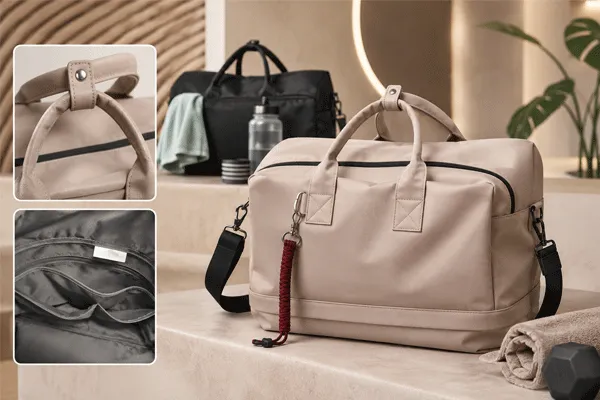
A single mesh panel on one end is decoration. Air needs an inlet and an outlet, which in practice means either mesh on two opposing faces, or mesh plus grommets in the base.
Three placements that behave differently in use:
Be honest with yourself about the contradiction here: every hole that dries the interior also lets rain in. If your target user commutes by bike or on foot in a wet climate, ventilation should be limited to the wet compartment and the main body should stay closed.
Sacs de sport personnalisés : compartiments pour vêtements mouillés, aération et points d'ancrage des sangles
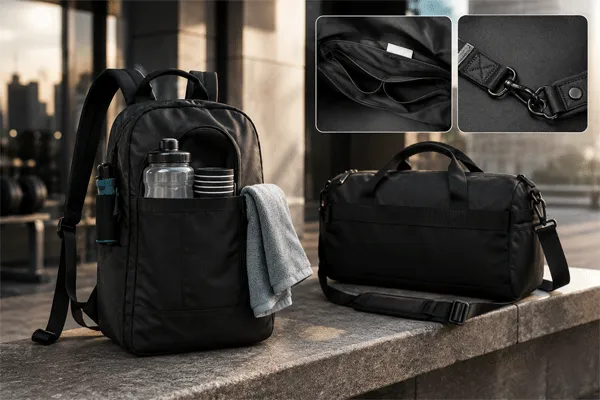
Polyester webbing rated well above the load will not break. What breaks is the fabric it is sewn to. When a shoulder strap tears out, the failure is almost always the body panel tearing around the stitch line.
What to specify:
Gym use is repeat loading, not single peak loading. A bag lifted onto a shoulder 400 times a year fails differently from one carried once on a flight.
Metal zippers on the compartment that holds chlorinated or salt-damp fabric corrode. Molded plastic or coil zippers with a coated tape are the usual answer for that specific pocket, even when the rest of the bag runs metal hardware for the look. Mixing zipper types across compartments on one bag is normal and not a defect — just document it, because inspectors flag inconsistency they were not told about.
Also specify puller type. A rubberized or cord puller is usable with wet hands; a flat metal tab is not.
Locker-room floors, gym mats, car boots. The base takes the abuse.
A removable bottom board has a quiet advantage: the user can pull it out to dry the bag properly, which is the single most effective smell prevention there is.
Antimicrobial liner treatments and coated fabrics exist and can be sourced. What they cannot do is carry a marketing claim without documentation. If you intend to print anything about antibacterial or odour-resistant performance, the treatment needs a test report from the material supplier, tied to the specific lot you are buying. Otherwise the safe copy is descriptive: “coated liner, wipes clean.”
On chemical restrictions generally, REACH (EU) and California Proposition 65 are the frameworks most buyers write into purchase agreements for bags and textiles, and ISO 9001 is the general quality-management framework often referenced in supplier qualification. These are industry-wide reference standards; treat them as requirements you place on a project, not as a certification claim about any particular supplier unless that supplier provides original certificates with numbers and issuing bodies.
They are different problems. A shoe compartment needs volume, ventilation, and abrasion resistance. A wet compartment needs impermeability and a drain path. A shoe compartment lined for waterproofing turns into a sealed box that holds moisture against the shoes — the exact opposite of the intent.
If your product needs both, they are two builds: a vented lower drop-bottom for footwear, and a smaller sealed or coated side pocket for towels and swimwear. Specifying one and expecting both is how a sample gets rejected after tooling is already paid for.
Sacs de sport personnalisés : compartiments pour vêtements mouillés, aération et points d'ancrage des sangles
Custom duffels at this factory are built to buyer specification across five dimensions: material, structure, hardware, branding, and packaging. Available material directions include fabric, leather, functional, and heavy-duty constructions, with ECO material options available. Concrete parameter values — body dimensions, fabric weight, liner type, zipper gauge, webbing width, hardware finish — are set per project and confirmed on the spec sheet rather than published as a fixed catalogue.
Fill this in with the factory before the first sample:
| Paramètres | Your value | Why it matters here |
| Body dimensions (L×W×H) | Locker fit, drop-bottom height loss | |
| Body fabric type / weight | Abrasion and shape retention | |
| Base fabric / laminate | Wet-floor contact | |
| Wet compartment type | See section 1 | |
| Liner material and coating | Water containment, cleanability | |
| Ventilation type and placement | Drying vs. rain resistance | |
| Zipper type per compartment | Corrosion on the wet pocket | |
| Strap reinforcement construction | Anchor pull-out resistance | |
| Finition des éléments métalliques | Corrosion, brand look | |
| Logo method and placement | Seam and mesh conflicts | |
| Packaging / polybag / carton spec | Export readiness, retail presentation |
Trial orders and sampling-first workflows exist for exactly this reason: the cost of one rejected sample is far below the cost of a container of bags with a liner that leaks along a stitch line.
A: MOQ is flexible and set per project, and trial orders are supported for new programs. It moves with construction complexity: a welded-liner build carries a higher practical minimum than a lined pocket on an existing pattern. Confirm the number against your chosen construction rather than assuming a single factory-wide figure.
A: A lined side pocket or a detachable pouch, usually yes, with pattern adjustment. A welded liner or drop-bottom section is a structural change and effectively a new build.
A: No, and the distinction matters for your product copy. Fully sealed bags use welded seams throughout and rarely ventilate. Most gym bags are water-resistant bodies with one contained wet section — which is what users actually want, since a fully sealed bag traps the smell inside.
A: It depends on material availability and whether tooling is needed for logo or hardware. Ask for the lead time as two separate numbers — sample lead time and bulk production lead time — because a fast sample does not guarantee a fast run.
A: Yes. Buyer-specified third-party inspection is supported. Name the inspection body and AQL level in the purchase agreement before production starts, not after.
A: Structurally: a removable bottom board, cross-flow ventilation, and a liner that can be wiped down. Behaviourally, the user has to open the bag to dry it, which is worth saying in your product care card rather than promising a fabric will solve it.

Nous vous répondrons dans les 24 heures. En cas d'urgence, veuillez ajouter WhatsApp/WeChat : +86 15066236153,. Ou appelez directement +86 17657177170.
*Nous respectons votre confidentialité et toutes les informations sont protégées.
Nous n'utiliserons vos informations que pour répondre à votre demande et n'enverrons jamais de courriels non sollicités ou de messages promotionnels.
 dernier blog
