









Sacos de viagem personalizados: capacidade, reforço da base e as especificações que determinam as devoluções
14 de agosto de 2026
ONIA BAG Technical Team | Published August 14, 2026
A saco de duffel is a load-bearing product, not a printed surface. Capacity numbers, base board reinforcement, seam stitch type, and zipper gauge determine whether a bag survives repeat loading — and most of the returns traced back to construction, not print quality, come from one of these four specs being left unspecified.
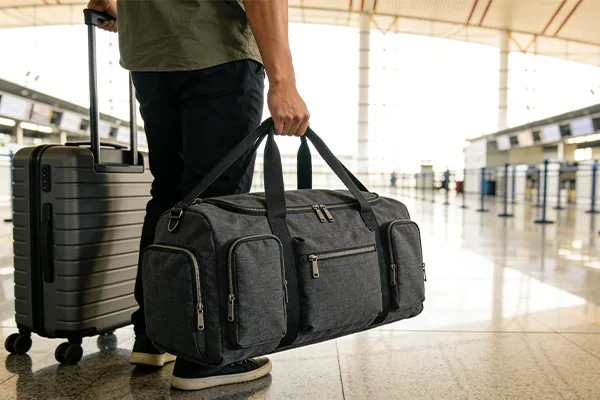
Sacos de viagem personalizados: capacidade, reforço da base e as especificações que determinam as devoluções
A duffel listed at “40L” or “2,400 cubic inches” is describing one of two different things, and buyers rarely ask which. Rated capacity is a geometric calculation — length times width times height, or the volume of the empty shell measured flat. Packed capacity is what actually fits once the bag has structure, internal pockets, and a base board taking up interior space. The gap between the two can run large enough that a “40L” duffel from one factory holds noticeably less than a “40L” duffel from another, with no error on either side — they measured differently.
For a brand owner writing a spec sheet, the fix isn’t picking a bigger number. It’s specifying the measurement method: flat-shell volume, or packed capacity with a stated fill test (for example, “capacity tested with 1L bottles packed to shape”). Without that line, a factory will default to whichever method makes the number look best, which is standard practice, not a red flag — but it does mean the buyer inherited an ambiguous spec.
The base of a duffel takes more sustained load and abrasion than any other panel — it’s set on floors, gym benches, car trunks, and airport belts, usually while carrying the bag’s heaviest contents. Three reinforcement approaches show up across the category, in ascending order of durability and cost:
The step buyers skip most often is specifying which of the three they’re getting. “Reinforced base” on a spec sheet with no further detail can legally be satisfied by any of the three approaches above, and a factory quoting the cheapest one isn’t cutting corners — it’s answering the spec as written.
Stitching at stress points is where sacos de viagem most commonly fail before the fabric does. Two constructions matter for anywhere a strap, handle, or base meets the body panel:
Stitch density (stitches per inch, commonly abbreviated SPI) also affects seam strength, though it’s a smaller lever than construction type — a bar-tacked point at a lower SPI will still outperform a straight-stitched point at a higher one. For a private label buyer without in-house technical packs, the practical move is naming bar tack or box-X at each named stress point (handle base, strap anchor, base corners) rather than leaving “reinforced stitching” as an unspecified instruction.
Zipper gauge (commonly written as #3, #5, #8, or #10, referring to the width of the coil or tooth in millimeters) is one of the few duffel specs with an actual numeric standard behind it, and it’s frequently left off RFQs entirely. A lighter gauge zipper on a main-compartment opening that gets loaded and unloaded daily is a common return-driver in gym and travel duffel categories — not because the zipper is defective, but because it was specified for a lighter-duty application than the one it ended up in.
Beyond gauge, three related specs are worth writing in:
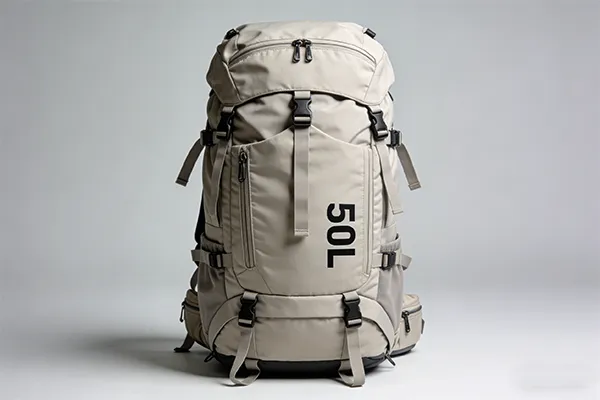
Sacos de viagem personalizados: capacidade, reforço da base e as especificações que determinam as devoluções
A duffel’s carrying strap sees the most cyclical stress of any component — loaded, unloaded, shoulder-slung, dropped — thousands of times over a bag’s life. Attachment method matters more here than webbing width alone:
Neither approach is universally correct; wrap-through suits a fixed-load gym duffel, while ring attachment suits a travel duffel where the strap needs to detach or adjust length frequently.
Denier measures the linear mass of the fabric’s yarn, not the finished fabric’s resistance to abrasion or tearing on its own. A 600D polyester with a loose weave and no coating can abrade faster at a stress point than a 420D fabric with a tight ripstop weave and a PU or PVC backing coat. Weave density and coating do more work than the denier number alone, particularly at the base and along zipper tracks where repeated friction — not tension — is the main wear mechanism. A spec sheet that states denier without weave type or coating is specifying half the relevant information; a factory can hit the denier number with a fabric that still wears through faster than a lower-denier alternative.
| Spec Area | Entry Tier | Mid Tier | Load-Rated Tier |
| Base | No insert | Removable HDPE-type board | Sewn-in board with molded feet |
| Stress-point stitching | Straight stitch | Bar tack at handle only | Bar tack + box-X at all load points |
| Zipper gauge | Lighter gauge, standard slider | Mid gauge, standard slider | Heavier gauge, self-repairing slider option |
| Strap attachment | Stitched anchor only | Stitched anchor, reinforced | Wrap-through or ring-mounted |
| Melhor ajuste | Light promotional giveaway use | General retail duffel | Gym, travel, or daily-carry programs with repeat loading |
Where a specific program sits on this table is a cost decision, not a quality judgment — an entry-tier promotional duffel handed out at a conference doesn’t need load-rated base construction, and specifying it there raises unit cost without a matching use case.
IONIA BAG has operated as a factory-direct manufacturer since 2010, with Mochilas de Viagem listed among its core product categories and customization available across materials, structure, hardware, branding, and packaging. Construction-tier defaults — which base reinforcement, stitch type, and zipper gauge ship standard versus which require a spec upgrade — are set per project once a tech pack or amostra request comes in, and are not published as fixed parameters on the empresa‘s public site.
| Campo | Status |
| Standard base reinforcement type offered | A confirmar consoante o modelo |
| Bar tack / box-X stitching as standard vs. upgrade | A confirmar consoante o modelo |
| Zipper gauge and slider options (self-repairing availability) | A confirmar consoante o modelo |
| Strap attachment method (wrap-through availability) | A confirmar consoante o modelo |
| Fabric weave/coating options at each denier tier | A confirmar consoante o modelo |
| Wash-tested or load-tested samples available | To be confirmed by company |
This article does not include confirmed product-level specifications for IONIA’s duffel bag line; it should not be published until the fields above are filled in or explicitly marked as unavailable.
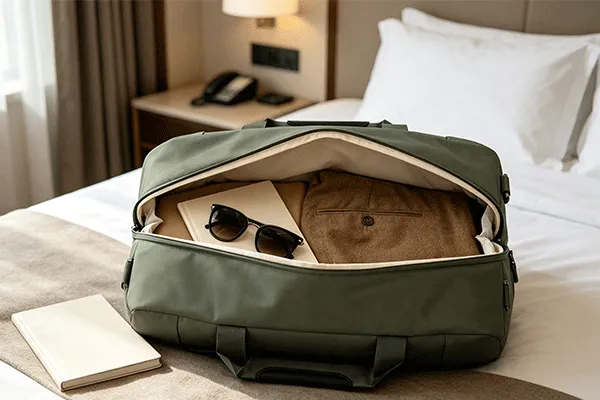
Mochilas de Viagem
Compared to typical branded-reseller duffel programs, which compete primarily on recognizable brand names and per-unit price across a catalog of pre-built styles, a factory-direct construction conversation starts from the opposite end — base reinforcement, stitch type, and zipper gauge as line items a buyer chooses, rather than fixed attributes bundled into an existing SKU. That trade-off cuts both ways: a reseller program offers a known, already-tested construction with brand recognition attached; a factory-direct spec conversation offers control over exactly which construction tier a program needs, at the cost of doing the specifying work this guide walks through.
A: There’s no single correct answer without knowing daily-use intensity, but a gym duffel opened and closed daily under load is a heavier-duty application than a giveaway tote, and gauge should be specified accordingly rather than left to factory default. Confirm the exact gauge options available for a given project before finalizing.
A: A sewn-in board with feet generally holds up better under sustained heavy loading since it can’t shift or wear a hole through the base pocket over time, but it also adds rigidity that some travel-duffel use cases don’t want. Match the choice to the load pattern, not automatically to the “better” option.
A: No — denier alone doesn’t determine abrasion resistance. Weave type and coating affect wear resistance at least as much as the denier number, particularly at the base and along zipper tracks.
A: Not publicly disclosed as of this writing; MOQ depends on construction tier, fabric, and hardware selected. To be confirmed by company before publishing MOQ-specific claims.
A: Sampling is generally the point to verify base reinforcement, stitch points, and zipper gauge match the spec sheet before committing to bulk production, though whether load-tested or wash-tested samples are available for a specific order needs confirmation per project.

Nós responderemos dentro de 24 horas. Se for um caso urgente, adicione WhatsApp/WeChat: +86 15066236153. Ou ligue diretamente para +86 17657177170.
*Respeitamos sua confidencialidade e todas as informações são protegidas.
Usaremos suas informações apenas para responder à sua consulta e nunca enviaremos e-mails não solicitados ou mensagens promocionais.
 último blog
