


Mini Leather Crossbody Bag for Women: What Should Handbag Brands Specify?
November 10, 2026
A beautiful small handbag can become a costly product mistake. Limited storage, tight openings, and weak attachments often go unnoticed until customers complain. For private-label buyers, the solution is to confirm exact dimensions, construction details, and quality standards before bulk production.
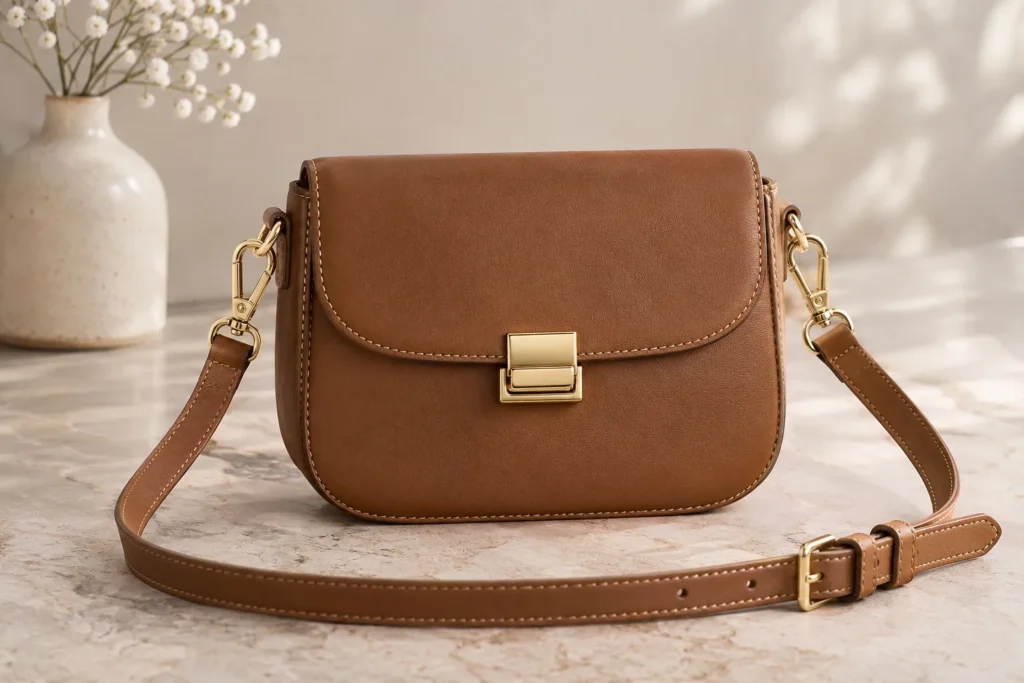
To develop a mini leather crossbody bag for women, brands should define usable interior space, opening width, material thickness, closure type, carrying fit, and manufacturing tolerances. Physical samples must prove that everyday essentials fit comfortably and that the approved design can be reproduced consistently. These checks help reduce production errors, returns, and unnecessary development costs.
Mini Leather Crossbody Bag for Women: What Should Handbag Brands Specify?
A small handbag is not simply a larger design reduced in size. When manufacturers shrink a pattern, the relationship between the body, opening, lining, hardware, and internal space changes. A product may look balanced in a drawing but become difficult to use after the lining, reinforcement, and closure are installed.
For a woman choosing a compact accessory, the main appeal is convenience. She wants enough room for daily essentials without unnecessary bulk. A well-developed mini crossbody should look refined, feel comfortable, and provide easy access to personal items. For private-label buyers, these expectations must become measurable product requirements.
The most important differences involve:
A small leather crossbody bag also needs careful material placement. Thick folded edges, bulky seam allowances, and poorly positioned attachments can create unwanted distortion.
The challenge is to create a practical, attractive item without making it unnecessarily complicated.
For B2B buyers, the right starting point is a functional specification, not just a reference photograph.
The best dimensions depend on what the customer needs to store. Rather than choosing a size because it appears fashionable, begin with the objects the finished product must accommodate. A phone, slim wallet, keys, and a few small personal items provide a useful starting point.
External measurements alone are not enough. A product measuring 19 cm across may have considerably less usable width because of side seams, internal padding, curved corners, or a thick lining. The opening can also restrict access even when the interior is large enough.
The following measurements illustrate possible development directions. They are concept examples, not fixed IONIA BAG specifications or proven market standards.
| Product Concept | Illustrative External Size (W × H × D) | Intended Use | Main Development Concern |
|---|---|---|---|
| Phone-focused | 18 × 12 × 5 cm | Basic daily essentials | Opening clearance |
| Everyday compact | 20 × 14 × 6 cm | Personal items and small accessories | Internal organization |
| Structured fashion | 21 × 15 × 7 cm | Retail fashion collections | Shape retention |
| Slim profile | 19 × 13 × 4 cm | Minimal daily contents | Thickness and access |
Imagine that your target device is approximately 16.5 cm long. An opening measuring exactly 16.5 cm may still be difficult to use because the product needs clearance for inserting and removing the device.
A development team should test the actual reference objects, including protective cases, rather than relying only on nominal dimensions.
For a compact cross body bag, confirm:
A physical fit test is more reliable than assuming that the advertised dimensions guarantee usable capacity.
The opening system affects both usability and production cost. A beautiful silhouette can become frustrating when customers cannot reach their belongings. In compact products, the position of the closure matters almost as much as its appearance.
A flap creates a refined, often vintage-inspired look. A zipper can offer a more enclosed opening, while a magnetic fastening may allow quicker access. Each solution requires different construction details, material allowances, and quality checks.
| Closure Option | Main Advantage | Development Concern |
|---|---|---|
| Zipper | Enclosed storage | Opening length and smooth operation |
| Magnetic flap | Clean appearance and convenient access | Alignment and holding force |
| Snap button | Simple closure | Reinforcement around the fitting |
| Turn lock | Decorative premium appearance | Metal weight and installation accuracy |
| Open top | Easy access | Limited content retention |
A flap-style product should be tested when filled, not only when empty. The closure must still align after common personal items are placed inside. Likewise, the front panel should not distort when the customer opens and closes it.
Another important point is compartment placement. A divider that looks useful in a technical drawing may reduce the available space too much after production.
For a small-format design, one practical main section and carefully selected internal storage often work better than several narrow compartments.
The rule is simple: every structural feature should earn its place.
Material selection should start with the required appearance, flexibility, and construction method. Genuine leather can support a premium position, but its natural characteristics require careful selection, cutting, and sample approval.
A pebbled leather finish may help create a textured appearance that suits a refined everyday product. A smoother surface can provide a cleaner look, but it may reveal scratches, dents, or uneven handling more clearly. The final choice depends on the intended finish and customer expectations.
Other material options include PU leather and selected synthetic alternatives. These can support different price targets and visual requirements. However, the buyer should confirm their performance instead of assuming that all products with similar surface appearances behave the same way.
| Specification | What to Confirm | Why It Matters |
|---|---|---|
| Material type | Genuine or synthetic | Product description and positioning |
| Thickness | Agreed range and measurement method | Foldability and seam bulk |
| Surface finish | Smooth, textured, embossed | Appearance and consistency |
| Flexibility | Required bending behavior | Comfortable construction |
| Backing | Structure and support layers | Shape retention |
| Surface resistance | Relevant abrasion and rubbing performance | Durability during use |
| Batch reference | Approved swatch or sample | Repeat-order consistency |
For a small product, material thickness deserves special attention. Folding two or three layers together can create a bulky edge, especially around narrow corners.
The cutting pattern, skiving requirements, reinforcement, and edge treatment should therefore be evaluated together.
When buyers need formal testing, ISO 11640 provides a recognized method for evaluating leather surface behavior during rubbing. Test requirements and acceptance criteria must be defined according to the actual project.
A high-quality result depends on matching the material to the construction, not simply choosing the most expensive option.
Mini Leather Crossbody Bag for Women: What Should Handbag Brands Specify?
The carrying system should match the body’s proportions. On a small product, a wide attachment or heavy metal component can change the appearance and balance of the entire design.
An adjustable strap gives users flexibility, but its length range, width, material, and attachment positions must be specified. A detachable option may also allow the same model to function as a shoulder bag or clutch.
A short handle can create another retail variation, although it may require additional reinforcement and manufacturing steps.
| Component | Buyer Specification | Sample Check |
|---|---|---|
| Length-adjustment buckle | Material, dimensions, finish | Smooth adjustment |
| Swivel hook | Size, attachment type | Rotation and connection |
| D-ring | Wire thickness and dimensions | Attachment stability |
| Metal fittings | Finish and approved reference | Visual consistency |
| Attachment tab | Material and reinforcement | Stitching and strength |
| Detachable system | Connection and removal method | Secure operation |
An attachment should be evaluated as a complete system. Strong metal hardware alone does not prevent failure if the surrounding material or stitching is inadequate.
The same principle applies to a sling-inspired design or a cross body purse intended for frequent movement.
Silver fittings may suit a clean modern collection, while warmer metal finishes may support a more traditional appearance. Whatever the choice, the components should work together visually.
For buyers, hardware standardization can also make future repeat orders easier. Using an approved set of fittings across related products reduces unnecessary variations in purchasing and inspection.
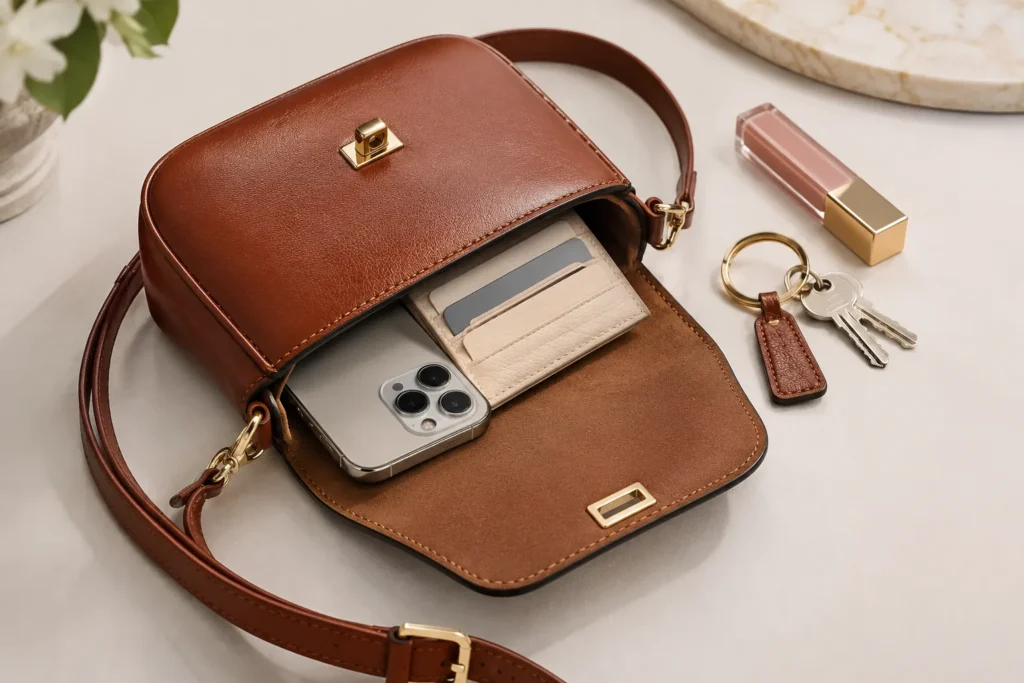
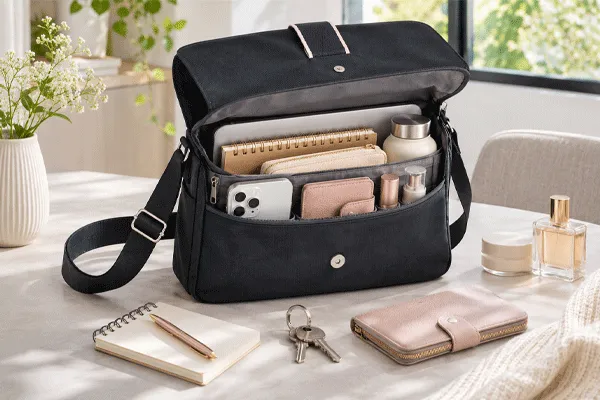
A compact product should prioritize access over excessive organization. One poorly placed pocket can reduce the usable interior more than it improves convenience.
Start with the customer’s essential items. A typical daily-use concept might need enough room for a mobile device, cardholder, keys, and a small cosmetic item. If the target customer carries larger objects, the dimensions should be reconsidered rather than adding more sections.
Useful features can include:
The interior must also support the intended exterior shape. Very thick dividers, excessive padding, or bulky seams can make a slim model look swollen.
During sampling, place the actual reference items inside the product and check whether they can be removed easily. Test the opening while the product is worn, standing on a table, and held in one hand.
A compact everyday-use model should not require the customer to empty the entire interior to find one small object.
This approach also helps product developers decide whether additional features are truly necessary.
For instance, a separate card section may improve convenience, but an elaborate multi-layer interior can increase labor and reduce storage capacity.
A well-designed interior is measured by how easily it works, not by the number of features it contains.
Private-label collections need recognizable design details, but too many changes can make production difficult. The aim is to create a consistent appearance through shape, surface texture, edge finishing, hardware, and carefully selected accents.
A brown leather design may appeal to customers seeking a classic appearance. Green can provide a more noticeable seasonal option, while dark neutral finishes can support a wider range of retail presentations.
The brand should choose a clear color direction and confirm it against physical samples. Photographs are useful for communication, but lighting and screens can distort the actual material appearance.
Other finishing choices include:
A handmade appearance is sometimes part of a product concept. However, brands should only describe goods as handmade when the production process genuinely supports that claim.
For IONIA BAG’s private-label customers, customization can be developed through the Handbags product category and the Crossbody collection.
A unique visual identity does not require excessive decoration. Often, a well-proportioned silhouette, consistent metal finish, and clean stitching create a stronger impression than multiple decorative additions.
The material price is only one part of the final unit cost. Small leather products can require careful cutting, edge preparation, precise stitching, and multiple assembly steps. Reducing the finished dimensions does not always reduce labor in the same proportion.
For importers and distributors, it is important to understand which specifications affect cost before requesting affordable prices.
The main cost factors include:
| Cost Factor | Why It Changes the Quotation | Possible Development Decision |
|---|---|---|
| Material grade | Different purchase and cutting costs | Confirm the required finish |
| Cutting efficiency | Irregular shapes can increase waste | Review pattern layout |
| Number of components | More parts create more assembly steps | Simplify unnecessary pieces |
| Hardware | Special finishes may increase sourcing complexity | Standardize suitable components |
| Edge treatment | Multiple finishing stages require labor | Compare construction methods |
| Branding | Different techniques require different processes | Select one clear logo method |
| Packaging | Retail presentation affects material and packing cost | Define requirements early |
Consider a hypothetical private-label collection built around one leather mini silhouette. The buyer wants two material finishes and three retail variations.
Instead of developing three unrelated patterns, the team could begin with one shared structure and adjust selected components. This may reduce duplicated development work while keeping the individual products visually distinct.
The actual savings would depend on material yield, production efficiency, order quantities, and component availability. They should be confirmed through quotations, not assumed in advance.
A best selling product is not necessarily the cheapest to manufacture. Its commercial value depends on the balance between production cost, retail positioning, reliability, and customer satisfaction.
For more information about project-based quotations and manufacturing options, explore IONIA BAG’s OEM/ODM solution.

Mini Leather Crossbody Bag for Women: What Should Handbag Brands Specify?
Quality inspection is especially important for compact leather goods because small visual differences can be easy to notice. Misaligned closures, uneven corners, inconsistent stitching, or irregular edge finishing can affect the appearance of an entire retail collection.
The approved sample should define the expected result. It is not enough to approve only the front appearance. Buyers should confirm internal dimensions, component placement, functional performance, and packaging requirements.
| Inspection Point | Verification Method | Acceptance Basis |
|---|---|---|
| Finished dimensions | Measure agreed reference points | Approved specification |
| Opening clearance | Insert and remove reference objects | Approved functional sample |
| Closure alignment | Open and close repeatedly | Agreed performance requirement |
| Stitching | Visual inspection and relevant strength checks | Approved workmanship standard |
| Attachment strength | Project-defined functional testing | Agreed load and method |
| Surface appearance | Compare with approved material reference | Approved appearance range |
| Edge finishing | Inspect curves and folded sections | Approved sample |
| Packaging | Check labeling and presentation | Buyer-approved packing specification |
For genuine leather products supplied to the European Union, buyers should also evaluate applicable chemical requirements.
This is one example of a regulated requirement, not a complete compliance checklist. Applicable rules depend on the destination market, materials, and product characteristics.
At IONIA BAG, we incorporate material checks, production inspection, finished-product verification, and packing checks into our manufacturing workflow. Buyer-requested third-party testing and inspection can be coordinated according to project needs.
You can review our manufacturing and quality support for further details.
A reference image is useful, but it cannot communicate every manufacturing requirement. A production-ready specification should include measurements, drawings, material references, hardware information, branding details, and practical acceptance criteria.
At IONIA BAG, we support OEM, ODM, and private-label development for global importers, distributors, retailers, and product businesses. Our team works with buyers to translate product concepts into samples and agreed production specifications.
For a new small-format handbag project, we recommend a structured approval process.
Provide the target market, intended customer, product use, expected retail positioning, and estimated purchasing quantity.
Include clear reference photos or drawings. If you have an existing sample, explain which features should remain unchanged and which require improvement.
Discuss the intended dimensions, material selection, surface finish, closures, hardware, lining, logo method, and packing requirements.
Pay particular attention to the clear opening, usable interior dimensions, and proportional accuracy.
The first sample is used to assess whether the concept can be made as intended.
Buyers should examine the product physically, review actual item fit, evaluate comfort, and identify any required adjustments before approval.
The pre-production sample should represent the final confirmed design, materials, components, and workmanship.
Once approved, the manufacturer can use it as the reference for production planning and quality control.
Confirm order quantities, material availability, inspection requirements, packaging specifications, and the delivery schedule.
Sample and production lead times depend on the final design, materials, and order conditions.
For more details, visit our custom sample development service.
| Information | Example |
|---|---|
| Product category | Mini leather handbag |
| Target market | North America or Europe |
| Design reference | Sketch, drawing, or physical sample |
| Dimensions | Required external and usable internal measurements |
| Material | Selected genuine or synthetic leather |
| Hardware | Preferred fittings and finish |
| Branding | Logo position, label, or embossing |
| Quantity | Estimated volume by version |
| Packaging | Retail-ready or standard export packing |
| Requirements | Inspection, testing, and documentation needs |
A clear request helps the manufacturing team evaluate the project accurately and suggest practical development options.
Develop Your Private-Label Collection with IONIA BAG
Whether you are creating a new compact fashion accessory or improving an existing design, our goal is to help you move from an attractive concept to a product that can be manufactured consistently.
Share your drawings, reference images, target specifications, and estimated order quantity through our Contact page. We can review suitable materials, product construction, sampling requirements, and the next steps toward bulk production.
The main difference is usable capacity. A smaller design usually holds fewer personal items and requires closer attention to internal space, opening clearance, and component proportions. A regular model may provide more storage flexibility.
Yes. Genuine leather can be used for premium compact products. The selected thickness, finish, flexibility, and reinforcement should match the intended construction. Sampling is important because different materials can behave differently around folded edges and curved sections.
Yes. Buyers can specify adjustable or detachable options according to the required appearance and function. The attachment points, fittings, and surrounding reinforcement should be checked during sampling.
The usable opening is often as important as the exterior width. Buyers should test the actual target devices, including protective cases, and confirm that customers can insert and remove them comfortably.
Yes. Related variations can use a common construction while changing selected materials, colors, or branding details. Each variation should still be checked for material consistency and manufacturing feasibility.
Yes. IONIA BAG provides OEM/ODM and private-label manufacturing support for fabric and leather product categories. Buyers can submit reference images, drawings, or existing samples for project evaluation and development planning.

We will reply you within 24 hours. If for urgent case, please add WhatsApp/WeChat: +86 15066236153,. Or call +86 17657177170 directly.
*We respect your confidentiality and all information are protected.
We will only use your information to respond to your inquiry and will never send unsolicited emails or promotional messages.
 last blog
