


Monogrammed Handbags and Totes: Production Options for Retail Personalization Programs
October 29, 2026
IONIA BAG Content Team | Factory Sourcing & Production Content | Published: October 29, 2026 · Last updated: October 29, 2026
A monogrammed handbag or tote carries a customer’s initials applied by embroidery, hot stamping, debossing, printing, or an attached patch or charm. For retail programs, the decision that matters is where the letters are applied: at the factory in pre-set batches, or at the counter on blanks built to accept personalization.
Monogrammed Handbags and Totes: Production Options for Retail Personalization Programs
Information note: This article reflects general bag-production practice as of October 2026. It does not quote IONIA prices or claim any certification. Product-level specifications and pricing are provided per inquiry.
On a production line, a logo and a monogram look similar but behave very differently.
A logo is fixed artwork. Every unit in the order gets the same mark in the same place, so the factory sets up once (a screen, an embroidery file, a stamping die) and repeats it thousands of times.
A monogram is variable data. Each unit may carry different letters, usually one to three initials, sometimes in a fixed font and layout chosen by the retailer. That variability is the whole production problem: the methods that are cheap for logos often become slow or uneconomical when every bag needs a different setup.
So “monogrammed handbag” can mean two separate products:
Most retail personalization programs that run in-store rely on the second model, sometimes with a small pre-monogrammed range for online or gift periods.
The appeal is practical. A personalization service turns a standard SKU into an item that cannot be bought identically anywhere else, and it gives shoppers a reason to buy in-store rather than waiting for delivery. It also shifts part of the gift decision to the retailer: the customer stops comparing bags and starts choosing letters.
The catch is that the retailer now runs a small finishing operation. Equipment, trained staff, letter dies or transfer stock, and a process for mistakes all become part of the bag program. That is why the factory specification of the blank matters as much as the counter equipment.
The table below compares common methods by surface, whether they suit factory batches, whether they work per-customer at a counter, and the failure point buyers most often meet in sampling.
| Method | Typical surfaces | Factory batch (fixed letters) | Per-customer at counter | Main failure point |
| Machine embroidery | Canvas, cotton, nylon, some PU | Well suited | Only on flat, hoopable, accessible panels | Backing and loose threads visible inside lined bags; puckering on thin fabric |
| Hot foil stamping | Genuine leather, PU, some coated canvas | Well suited | Well suited with a tabletop press and letter dies | Foil adhesion varies with surface finish; excess heat can mark PU |
| Blind debossing (no foil) | Leather, thicker PU | Well suited | Well suited with the same press | Low contrast on pebbled or heavily textured grain |
| Laser engraving | Leather, leather tags, some hardware | Possible | Possible, needs equipment and ventilation | Burn depth and color shift vary by leather tannage and finish |
| Screen printing | Canvas and cotton totes | Well suited for fixed artwork | Impractical (a new screen per design) | Setup cost per letter combination |
| Heat transfer (vinyl or DTF film) | Cotton, canvas, polyester | Well suited | Well suited with a heat press | Heat damage on nylon or coated fabrics; edge lifting after abrasion |
| Patches, letter charms, removable letters | Almost any bag | Factory supplies the letters and attachment points | Well suited, no heat or needle needed | Requires A-to-Z inventory and attachment hardware designed into the bag |
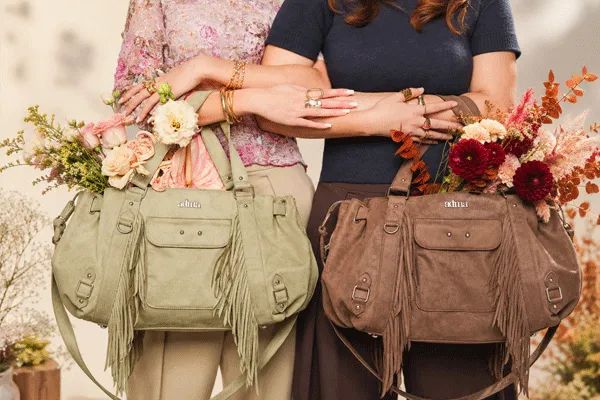
Two patterns stand out. Hot foil stamping and debossing are the traditional counter methods for leather and PU handbags because the setup per customer is just swapping letter dies. For canvas totes, heat transfer and attached letters are easier to run at a counter than embroidery, which usually needs access to the back of the panel.
Screen printing is the clear one-off case: excellent for a retailer’s own logo across a full order, poor for individual initials.
Many programs start with a finished handbag that already sells well, then try to add monogramming afterward. Sampling is where this goes wrong.
The issues are usually structural, not cosmetic:
None of these are fixable at the counter. They have to be designed out at the factory stage, which is why the monogram method should be chosen first and the bag built around it.
Monogrammed Handbags and Totes: Production Options for Retail Personalization Programs
For retail and project buyers working with a manufacturer, these steps turn a personalization idea into a production-ready brief.
A step is complete when it produces a written specification or a signed-off sample. If a step ends in “we’ll see at the counter,” it is not finished.
Some programs use both models. The comparison below shows the trade-offs that usually decide the mix.
| Factor | Factory pre-monogrammed batches | Counter personalization on blanks |
| Letter choice | Limited to the batches produced | Any combination the font set allows |
| Inventory risk | High: unsold letters cannot be reused | Lower: blanks stay sellable as plain bags |
| Handover time | Immediate, off the shelf | Depends on queue and method at the counter |
| Consistency | Controlled in one production run | Depends on staff training and equipment upkeep |
| Error cost | Factory QC catches errors before shipment | A misspelled bag is usually a write-off for the store |
| Store requirements | None beyond shelf space | Equipment, consumables, trained staff |
Compared with the print-on-demand personalization services common in e-commerce, a counter program asks the retailer to hold blank inventory and run equipment, but it delivers the finished item during the visit instead of days later.
IONIA BAG produces handbags and tote bags as a factory-direct OEM/ODM and private label manufacturer based in Qingdao, China, operating since 2010. For a monogram program, the relevant question is what can be built into the blank. The table shows what is available and what is confirmed per project.
| Specification area | What IONIA offers | Status |
| Product categories | Handbags, tote bags, shoulder bags, crossbody bags, canvas bags, shopping bags | Public product lines |
| Material directions | Fabric, leather, functional and heavy-duty materials, including ECO material options | Specific materials and finishes confirmed per project |
| Monogram zone construction | Customization of structure (panels, lining, tabs) | Defined in sampling against the buyer’s tech pack |
| Hardware | Hardware customization, including placement relative to the monogram zone | Confirmed per project |
| Fixed branding | Brand logo application | Method confirmed per project |
| Packaging | Custom packaging, including protection for the monogram surface | Confirmed per project |
| Model numbers, dimensions, weights | Not published | Provided on inquiry |
| Sampling | Sampling-friendly workflow; trial orders supported for new projects | Available |
| Inspection | Buyer-specified third-party inspection supported | Available |
Because personalization surfaces depend on the exact material and finish, IONIA recommends testing the store’s own equipment on pre-production samples before confirming bulk quantities.
Monogramming adds materials to the bag: foil, transfer film, adhesives, embroidery thread, inks. These count toward the finished product’s chemical compliance in the destination market.
Two frameworks come up most often in bag sourcing. The EU’s REACH regulation governs chemical substances in products sold in the European Union. California’s Proposition 65 requires warnings for products that expose consumers to listed chemicals. These are cited here as common industry standards, not as IONIA certifications.
For a counter program, the store buys foil and transfer consumables separately from the bags. Buyers should request compliance documentation for those consumables as well as for the bag materials, since the finished personalized item combines both.

Monogrammed Handbags and Totes: Production Options for Retail Personalization Programs
Advantages
Disadvantages that affect the decision
IONIA does not publish prices; costs for monogram-ready handbags and totes are quoted per inquiry. The main cost drivers are material and finish, construction around the monogram zone (unlined panels or lining zippers add sewing steps), hardware, branding method, packaging, and order quantity.
For accurate comparison between suppliers, send the same tech pack, with the monogram zone and counter method stated, to every factory you quote.
A: Hot foil stamping or blind debossing with a tabletop press is the usual choice. Staff swap letter dies per customer, and the result works on most genuine leather and many PU surfaces, though each finish should be tested first.
A: Only if the embroidery area is accessible and can be hooped flat. Unlined totes work best. For lined or structured totes, heat transfer or attached letter patches are easier to run in-store.
A: Factory letter batches suit gift seasons or online sales where popular initials are predictable. For open-ended in-store personalization, monogram-ready blanks carry less inventory risk.
A: Surface coatings and pigments differ between colorways, even within one material family. Foil adhesion and heat tolerance should be tested on every planned color, not only the first sample.
A: Yes. Foils, transfers, adhesives and inks become part of the finished product. Request compliance documentation for these consumables as well as for the bag materials, based on the destination market’s rules such as REACH or Proposition 65.
We will reply you within 24 hours. If for urgent case, please add WhatsApp/WeChat: +86 15066236153,. Or call +86 17657177170 directly.
*We respect your confidentiality and all information are protected.
We will only use your information to respond to your inquiry and will never send unsolicited emails or promotional messages.
 last blog
