








Genuine Leather vs Full-Grain Leather: What’s the Difference and Which Leather Is Better?
March 21, 2026
Buying a bag or wallet should feel simple But many buyers see labels like genuine leather and full-grain leather and still do not know what they are getting. That confusion can lead to weak sourcing decisions, lower product value, and unhappy customers. The fix is to understand the real difference between the two before you place a bulk order.
Full-grain leather usually keeps the natural surface of the hide, while genuine leather is a broader term that simply means the item is made from real leather. In practice, full-grain is usually preferred for premium bags because it keeps more of the hide’s natural structure and often develops a richer patina over time. Industry definitions also distinguish clearly between full grain, corrected grain, and split leather, which helps explain why material quality can vary so much from one product to another.

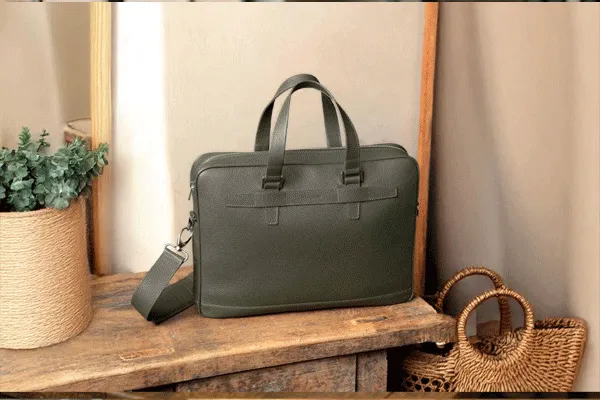
genuine leather vs full-grain leather bag material comparison for custom bag manufacturing
What is genuine leather?
What is full grain leather?
What is the main difference between genuine leather and full-grain leather?
Where do top grain and corrected grain fit in?
Is genuine leather vs full grain leather really about quality?
Which type of leather is better for bags, wallets, and private-label collections?
How do leather grades affect cost, performance, and brand positioning?
What should B2B buyers ask a supplier before ordering leather goods?
Which leather works best for OEM, ODM, and private-label projects?
How can you choose the right leather for your market?
If you source bags for import, wholesale, e-commerce, or brand retail, this guide is worth reading because the right leather product can change your margin, customer reviews, and repeat order rate. As a China-based custom bag manufacturer and OEM/ODM bag factory serving global bulk buyers, we see one pattern again and agai: the best result comes when buyers match the right leather to the right price point, market, and product story.
Genuine leather is real leather. That part is true. But the term is also a broad commercial label, not a guarantee of the highest quality leather. In the trade, the material may come from different parts of the hide and may go through more finishing, coating, or surface correction than premium grain leathers. That is why two items labeled genuine leather can feel very different in the hand.
Many buyers assume that if a tag says “genuine leather”, the material must be premium. Not always. It simply means the item is technically leather rather than faux material. Depending on how the hide was processed, the final result may be smooth, coated, embossed, or heavily finished. Some lower-cost products are even made from scraps of leather or leather scraps that are reworked into bonded material, which is different again from stronger natural-hide constructions.
For that reason, we tell B2B buyers not to stop at the label. Ask what layer of the hide was used, whether the surface was corrected, and how the leather is made and finished. Those questions matter far more than the word “genuine” alone.
Full grain leather is a more specific and more useful term. It refers to leather where the natural grain remains visible and the original surface is largely preserved. Leather Working Group definitions and peer-reviewed leather-industry materials describe full grain as leather where the grain layer remains visible rather than being heavily corrected or covered.
Because the outermost layer of the hide remains in place, full-grain leather keeps more of the natural strength, fiber structure, and character of the skin. That means you may still see a natural wrinkle, pore pattern, or small imperfection. For premium buyers, that is usually a strength, not a flaw. It shows authenticity and helps the material build a beautiful patina as the leather ages.
This is why many premium leather goods brands choose it. When buyers want a bag that feels rich, breathable, and built for long use, full grain leather comes up again and again as the preferred option.
The simplest answer is this: genuine leather vs full grain leather is mainly a question of precision and material quality. Genuine leather is a broad label for real leather. Full-grain leather describes a specific construction that keeps the original grain surface visible.
In many cases, full-grain material comes from the outermost layer of the hide, while lower-cost genuine constructions may come from lower layers or corrected surfaces. When makers sand or buff away blemishes, they create corrected grain leather. Leather-industry references explain that this process removes small irregularities and creates a more uniform surface, but it also changes the natural grain character.
So in plain words, what’s the difference? One label tells you the product is real leather. The other tells you more about how much of the hide’s original grain is still there.
This is where many buyers get confused. Top grain does not always mean the same thing as full grain leather, although they are closely related in retail language. In many sourcing conversations, top grain leather refers to leather from the upper part of the hide, but the surface may have been lightly corrected, buffed, or finished.
Leather-industry guidance explains that corrected grain leathers are produced after buffing away small surface defects. After that, the maker may apply coatings, resins, or finish layers, and sometimes emboss a new grain pattern onto the surface. That creates a cleaner visual look, but it also means the natural surface has been partly sanded away.
That is why buyers often compare full grain and top grain when developing premium bags. Both can be good. But top grain leather usually gives a more uniform appearance, while full-grain leather is the highest choice when a brand wants natural character, stronger identity, and a more authentic aging story.

Yes, but not in the oversimplified internet way. The phrase leather vs genuine leather is often used as if one side is fake and the other is real. That is wrong. Both are real leather. The true issue is whether the material is premium grain, corrected grain, split, or even bonded leather.
A lot of retail confusion comes from the fact that “genuine” acts like a catch-all phrase. It tells the buyer the product contains natural leather, but it does not clearly show the grade of leather, finish type, thickness, or how much coating is used. That is why one genuine leather bag may perform well and another may crack, peel, or feel stiff after a short time.
For product development, the smarter conversation is not grain vs genuine as a slogan. It is a technical review of structure, finish, hand feel, thickness, backing, and end use.
For premium collections, full grain leather is usually the better choice for many bags, wallets, and private-label accessories.It is often more resistant to wear, more natural in feel, and more likely to develop a rich surface rather than simply wearing out. Because the grain is still intact, the material tends to age with more depth and individuality.
For mid-range projects, top grain or corrected grain may still be the right answer. Why? Because some markets prefer a smoother, more uniform look. If a brand wants fewer visible marks, stable color, and easier surface matching across a large batch, corrected or top-grain options can be easier to control in production. Leather-industry references note that buffing and finishing help hide minor defects and create a more even appearance.
For entry-level promotional or high-volume retail, a lower-cost genuine leather option may be good enough. A branded wallet, pouch, or tote does not always need the highest grade of leather. It needs the right balance of appearance, cost, and expected lifespan.
There is no single universal consumer chart for all leather grades, but in sourcing practice buyers often compare full grain, corrected/top grain, split, and bonded materials. The strongest commercial point is simple: the more natural structure you keep, the more likely the material will support stronger story, appearance, and long-term value.
Here is a practical comparison:
| Leather Type | Surface | Typical Look | Performance | Best Use |
|---|---|---|---|---|
| Full grain leather | Natural grain kept | Rich, natural, unique | Often highly durable | Premium bags, belts, high-end wallet lines |
| Top grain leather | Upper surface lightly corrected | Cleaner, more uniform | Good balance | Fashion bags, retail collections |
| Genuine leather | Broad commercial label | Varies widely | Varies widely | Mid-range or cost-sensitive items |
| Split / coated leather | Lower split with finish | Uniform, processed | Lower natural feel | Budget goods |
| Bonded leather | Fibers or scrap bonded together with binders | Very uniform | Lower lifespan | Very low-cost accessories |
A premium brand story usually needs higher quality leather. A promotional campaign may need a lower-cost leather piece that still looks acceptable at scale. That is why the right sourcing choice depends on the market, not on one label alone.
First, ask what exact type of leather is being offered. Do not stop at “real” or “genuine.” Ask whether it is full grain, corrected grain, split, or coated. Ask if the material uses the top layer of the hide or a lower section. Ask how the finish is applied and whether the grain is natural, buffed, pigmented, or embossed. Those details are what separate high-quality leather from vague marketing.
Second, ask how the material will behave in your actual leather product. A travel duffel, office tote, cosmetic pouch, and slim wallet do not need the same leather. Some need softness. Some need body. Some need a scratch-friendly vintage look. Some need uniform branding and color repeatability. Good sourcing starts with end use.
Third, ask for photos, samples, cut edges, and wear testing if the order is large. We also recommend asking if the supplier can explain the expected patina, how the leather tends to react to moisture, and whether the finish includes acrylic or polyurethane layers. Transparency matters.
For OEM and private-label work, the best material is not always the most expensive one. It is the one that fits the brand promise. If the customer wants heritage, premium feel, and story-driven product pages, full grain leather vs lower-cost options usually wins. It gives stronger emotional value and clearer differentiation.
If the customer needs tight cost control, lower return rates, and a very consistent look across thousands of units, corrected grain or selected genuine leather products may fit better. This is common in large retail programs, gifting projects, and fast-turn e-commerce launches.
As a China-based custom bag manufacturer, we usually guide clients this way:
Choose full-grain leather for premium branding and long-term value
Choose top grain leather for a cleaner surface and balanced cost
Choose selected genuine leather for volume-focused programs where price matters most
That is how OEM and ODM programs stay both practical and competitive.
The right answer depends on your customer. A boutique lifestyle brand may want the unique character of natural grain. A corporate gifting buyer may want a neat and stable finish. An importer selling through marketplaces may need cost-efficient materials that still feel like quality leather at first touch.
We usually tell buyers to judge leather by five points:
Material structure
Surface finish
Target retail price
Expected life span
Brand story
That is also where many buyers see the real differences between genuine leather and premium grain constructions. One supports a stronger luxury message. The other may support faster market entry and lower unit cost.
Imagine two buyers ordering the same tote bag shape.
Buyer A is building a premium travel line. Their retail price is high, and they want the bag to age well. We would likely suggest full grain leather, visible natural grain, and minimal surface correction.
Buyer B is supplying a private-label chain store. Their priority is stable color, controlled cost, and fewer visible marks from hide to hide. In that case, a more corrected or selected genuine leather option may work better.
Same pattern. Different market. Different leather. That is how smart sourcing works.

PU leather / Vegan leather
Is genuine leather real leather?
Yes. Genuine leather is real leather, not synthetic material. But the label alone does not tell you whether it is full grain, corrected grain, split, or heavily finished.
Is full grain leather better than genuine leather?
Usually yes for premium applications. Full grain leather keeps more of the hide’s natural surface and usually offers better aging character and stronger perceived value.
Is top grain leather better than genuine leather?
Often yes, but it depends on the exact material. Top grain leather generally gives a more refined and consistent appearance, while genuine leather can vary widely in construction and finish.
Does full-grain leather last longer?
In many applications, yes. Because the natural grain and stronger fiber structure remain more intact, full-grain materials are often chosen when buyers want longer wear and better aging.
What is the highest quality leather?
For many premium bag and accessory uses, full grain leather is commonly treated as the highest quality option because it preserves the natural grain surface. Leather-industry materials specifically distinguish full grain as leather with the grain layer visible and intact.
Is bonded leather the same as genuine leather?
No. Bonded leather is usually made from leather fibers or fragments combined with binders, while genuine leather refers to real hide-based leather products.
Genuine leather means real leather, but it is not the same as premium grain leather.
Full-grain leather keeps the natural grain and is usually better for high-end bag projects.
Top grain often looks smoother and more uniform because the surface may be lightly corrected.
The most useful sourcing questions are about hide layer, finish, coating, thickness, and end use.
For OEM and private-label programs, the best leather depends on your target market and price point.
Premium brands often choose full grain for story and aging value, while volume programs may choose selected genuine or corrected grain materials.
Smart buyers compare material structure, not just labels.

We will reply you within 24 hours. If for urgent case, please add WhatsApp/WeChat: +86 15066236153,. Or call +86 17657177170 directly.
*We respect your confidentiality and all information are protected.
We will only use your information to respond to your inquiry and will never send unsolicited emails or promotional messages.
 last blog
